24MM BAYONET MOUNT LENSES
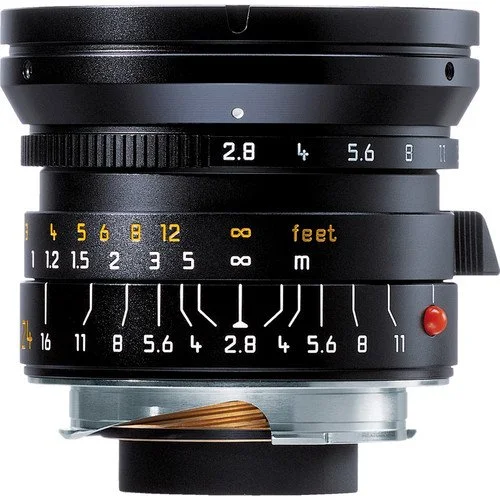
24mm f/2.8 Elmarit-M ASPH
Introduced at Photokina in 1996, 24mm f/2.8 Elmarit-M ASPH lens featured the molded aspherical lens technology204. The black finished 24mm f/2.8 Elmarit-M ASPH was the first 24mm wide-angle lens designed for the M system and set new performance standards in this focal length category, which photographers often preferred for dynamic shots in tight spaces215. It provided an angle of view of 84 degrees215. It consisted of seven elements arranged in five groups, including one aspherical surface, one element made of special glass with partial anomalous dispersion, and two additional elements crafted from highly refractive glass204. The lens had a length of 45mm from the bayonet flange, weighted 290 grams, and had a filter size of E55204. Its smallest aperture was f/16204. A separate bright-line viewfinder was available for use with this lens204.
As of 1998, this lens was available in a silver chrome finish, with a price of 2295 USD215. Overall, there have been 22000 lenses produced since 1996, with serial numbers ranging from 3737201 through 3872600439.

24mm f/1.4 Summilux-M ASPH
The Leica 24mm f/1.4 Summilux-M ASPH lens was introduced at Photokina 2008283. It complemented the Leica 21mm f/1.4 Summilux-M ASPH by offering comparable performance361.
While the 24mm version might have slightly lagged behind the 21mm version at maximum aperture, careful observation was needed to notice the difference361. In the past, it was challenging to fairly compare lenses with such vastly different apertures—like f/1.4 and f/3.8—only to identify minor differences361.
Choosing between the Leica 24mm f/1.4 Summilux-M ASPH, the 24mm f/2.8 Elmarit-M ASPH, and the 24mm f/3.8 Elmar-M ASPH should have been based purely on the intended use and the need for speed361. For reportage, documentary work, snapshots, and location photography—especially in fashion and portraiture—the high-speed capabilities of the 24mm f/1.4 Summilux-M ASPH lens allowed for a new type of imagery361. The Leica 24mm f/3.8 Elmar-M ASPH was excellent for snapshots with outstanding image quality, while the 24mm f/2.8 Elmarit-M ASPH served as a good compromise between speed and size361.
The 24mm f/1.4 Summilux-M ASPH had catalogue number 11601 for the black finish361. The lens construction included 10 elements arranged in 8 groups, with one aspherical surface and a floating group for enhanced performance361. It offered an angle of view of 84° and had a minimum focusing distance of 70 cm361. The lens weighted 500 grams and utilized a Series VII filter that fitted into the lens hood, which was a separate, screw-on type361.

24mm f/3.8 Elmar-M ASPH
The Leica 24mm f/3.8 Elmar-M ASPH was introduced at Photokina 2008283.
The 84-degree angle of view was quite intriguing, but it could have also been creatively challenging361. The Leica 24mm f/3.8 Elmar-M ASPH offered the smooth handling and solid feel characteristic of traditional Leica products361. The aperture ring featured very smooth click stops361. Notably, the Leica 24mm f/3.8 Elmar-M ASPH had a greater number of blades than the 24mm f/2.8 Elmarit-M ASPH (nine versus eight), and the shaped aperture was more circular, which resulted in better bokeh or out-of-focus rendering361.
The 24mm f/3.8 Elmar-M ASPH lens performed exceptionally well at all apertures361. Its size was extremely comfortable for casual snapshots361. For the discerning user, it delivered all the performance required for high-caliber exhibition-quality images361. The 24mm f/3.8 Elmar-M ASPH offered outstanding value for money and demonstrated a high level of performance361. There was hardly any photographic discipline where the 24mm f/3.8 Elmar-M ASPH failed to deliver impressively good results361.
The lens had catalog number 11604361. There were 8 elements in 6 groups with one aspherical surface361. Angle of view was 84º361. Minimum focusing distance was 70 cm361. Weight was 260 grams361. Filter size was E46361. There was 6-bit lens identification361. The lens included a screw-on type lens hood361.